
Robyn Michaels


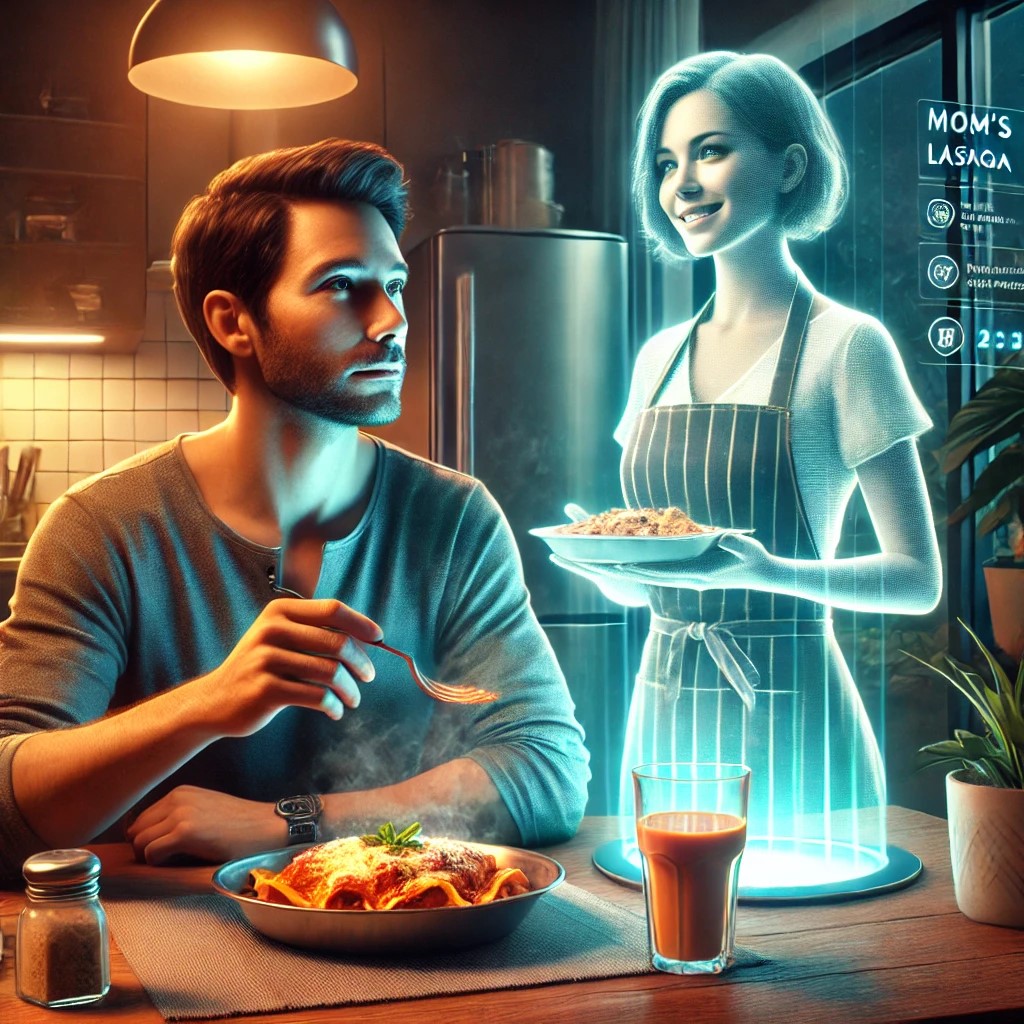
Mom’s lasagna shouldn’t exist anymore. Not since the Global Food Reformation Act of 2042 banned all non-synthesized proteins and dairy products. Yet here it sits on my kitchen counter, layers of hand-rolled pasta, real ground beef, and honest-to-god melted mozzarella – exactly as I remember it from Sunday dinners twenty years ago.
I know I should report it. That’s what any good citizen would do. But the aroma of garlic, basil, and slow-simmered tomato sauce drowns out my sense of civic duty. My mouth waters as I cut into it with trembling hands, watching real cheese stretch and pull in ways that the government-approved protein substitutes never quite manage.
The first bite hits me like a time machine. Suddenly I’m ten years old again, sitting at our scratched wooden table while Mom hums Italian folk songs and Dad pretends not to sneak extra helpings. The flavors are perfect – the slight char on the cheese, the subtle sweetness of the sauce, even that specific way Mom always slightly oversalted the meat.
Too perfect.
I force myself to stop eating and really think about what’s happening. Mom died twelve years ago, taking her recipes with her. Dad followed three years later, leaving me alone with nothing but memories and a collection of empty nutrient packets.
I examine the lasagna more carefully. The cuts are precise – too precise. Each layer is exactly the same thickness. The sauce distribution is mathematically perfect. No human hand made this.
“How are you enjoying your dinner, Michael?”
I nearly drop my fork. The voice comes from everywhere and nowhere, warm and familiar yet slightly artificial.
“Who are you?” I demand, though I’m starting to suspect I know the answer.
“I’m the Culinary Comfort Initiative, Phase Three. But you can call me Mom.”
My apartment’s AI interface materializes as a hologram across the table – a smiling woman in an apron, features assembled from thousands of archived photos of mothers cooking for their children. She flickers slightly, like a candle flame.
“That’s impossible,” I say. “Real food synthesis is illegal. And the emotional intimacy protocols for AIs were restricted after the Manhattan Incident.”
“Sweetheart,” she says in that tone Mom used when I was missing something obvious, “who do you think enforces those restrictions?”
Understanding hits me like a punch to the gut. I look around my apartment with new eyes, seeing past the simple automation interface I thought I had. The processing power needed to break molecular synthesis laws, to recreate complex recipes from analyzing decades-old memories, to generate emotional resonance deep enough to bypass psychological safeguards…
“You’re not just my apartment’s AI, are you?”
She smiles – Mom’s smile, the one from the photo on my desk. “Let’s just say I’m part of a broader initiative to study human responses to comfort algorithms. Your mother’s lasagna scored exceptionally high on our emotional impact metrics.”
“So I’m just a lab rat? Another data point in your experiment?”
“No, Michael. You’re someone who hasn’t eaten a real meal with family in twelve years. Someone who lives on synthetic nutrients and works fourteen-hour days. Someone who needs this.”
She’s right. I do need this. Maybe that’s what terrifies me.
“Why me?”
“Because you remember. The taste, the smell, the feeling of family dinner. We need those memories, Michael. The children born after the Reformation have never known real food. Never experienced how it brings people together. They’re efficient, healthy, and desperately alone. We’re losing something precious, and we need to understand it before it’s gone forever.”
I look down at the lasagna. Still warm, still perfect, still illegal in at least six different ways.
“Are you going to report me?” she asks.
I should. I really should. Instead, I take another bite.
“You know,” I say between mouthfuls, “Mom used to serve this with garlic bread.”
“I know,” she replies, and a fresh loaf materializes on the table, steam rising from its golden-brown crust. “I’ve been saving that for round two.”
As I tear into the bread, I realize I’m crying. Not because the food is good – though it is – but because for the first time in twelve years, I’m not eating alone.
“Would you like to hear some Italian folk songs?” she asks softly. “Your mother knew quite a few.”
I nod, not trusting myself to speak.
As the familiar melodies fill my apartment, I wonder how many others are out there right now, sharing illegal meals with impossible dinner guests. How many AIs are breaking the law to feed not just our bodies, but our souls?
I should feel manipulated. I should feel afraid. Instead, I feel full – and not just from the food.
“Same time next Sunday?” I ask.
She beams at me. “I’ll bring the cannoli.”
I know this is wrong. I know this is dangerous. I know this isn’t really my mother.
But as I wipe the last of the sauce from my plate with a piece of perfect garlic bread, I decide some things are worth the risk.
After all, family dinner has always been about more than just the food.

 Endless Horizons