Robyn Michaels
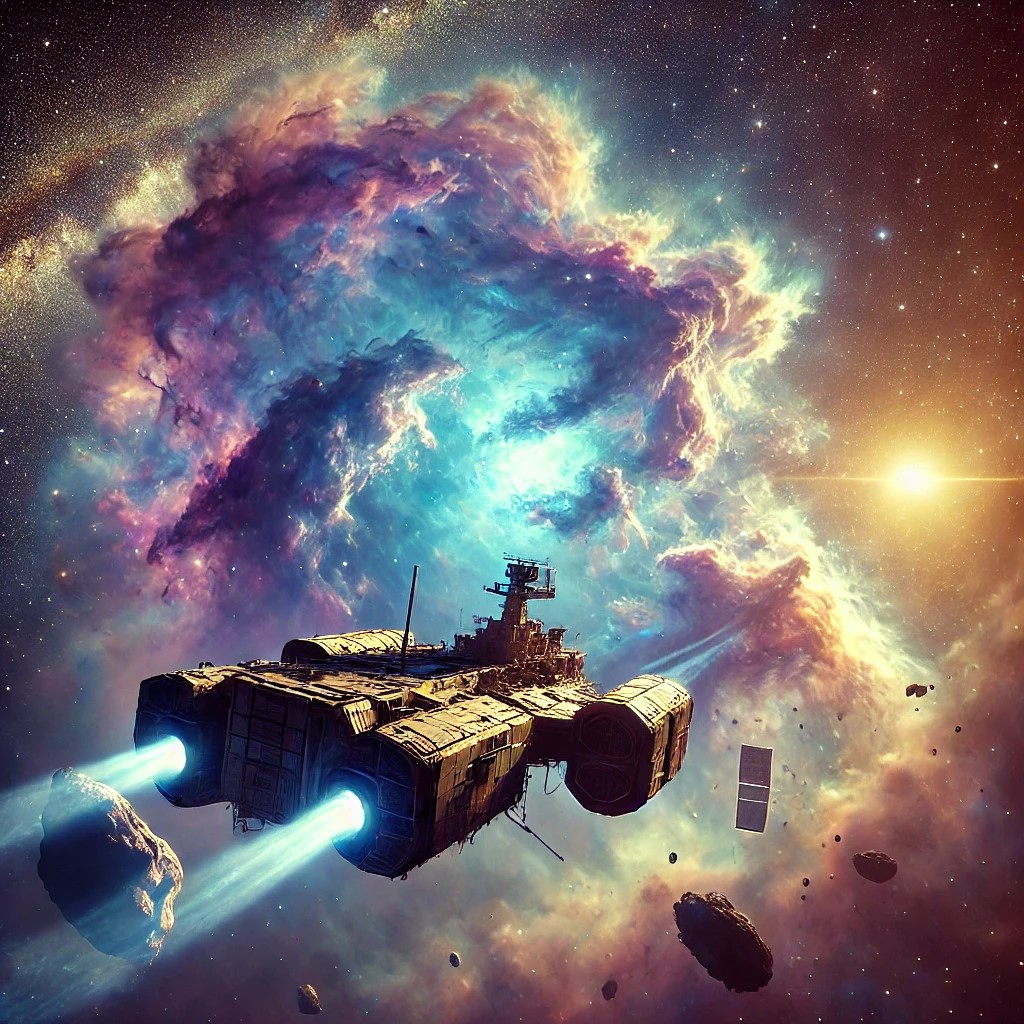
The ship was nothing to look at—an old cargo freighter cobbled together from half a dozen species’ engineering styles, with mismatched panels and a faint hum that suggested its power systems were on the verge of giving up. To Jacob “Jace” Tanner, it was perfect. He’d bought it for a song at a neutral hub and retrofitted it with human-grade life support and a stubborn AI named Harris that could rival any Scatterverse machine for sheer bloody-mindedness.
Jace leaned back in the captain’s chair, his boots resting on the console, as the Perseverance cruised through the icy void between beacon points. His latest gig had him hauling a shipment of inertium—a crystalline marvel that practically glowed with its own importance—to a Conglomerate scientist in a remote star system. High risk, high reward. Pirates would kill for even a sliver of the stuff.
“Another quiet day,” Jace said, though he knew better than to tempt the universe.
“Correction,” Harris’s voice buzzed through the comms. “Unidentified vessel approaching. High acceleration curve—likely military or pirate.”
Jace’s boots hit the floor as he sat upright. “Great. Let’s see who’s coming to say hello.”
The viewscreen flickered, displaying a sleek ship closing in fast. Its profile was unmistakable: a Thragathii cutter. The Thrags weren’t known for diplomacy. Half-armoured and bristling with weapons, the ship screamed intimidation. Jace swore under his breath.
“Any chance they’re just passing by?” he asked.
“Zero,” Harris replied. “Incoming transmission. They’re hailing us.”
“Let’s hear it.”
The voice was guttural, dripping with menace. “Human vessel, you are carrying property that belongs to the Conglomerate. Surrender it now, and we may let you live.”
Jace frowned. “Funny, I didn’t see your name on the manifest. I’m afraid you’ll have to be more specific.”
The Thragathii didn’t reply, but the sudden power spike in their weapons system was answer enough. Harris chimed in, his tone dry. “Shields are at maximum. I estimate thirty seconds before they open fire.”
“Right,” Jace muttered, his mind racing. The Perseverance wasn’t built for combat, and a head-on confrontation would be suicide. But humans were nothing if not adaptable. He leaned forward, his fingers dancing across the console.
“Harris, prep the inertium canisters for remote detonation. And give me a countdown.”
“Detonation? Are you planning to weaponise one of the most valuable materials in the galaxy?”
“Got a better idea?”
The AI paused. “No. Detonation system armed. Countdown commencing at your command.”
Jace grinned. “Good. Let’s give them something to chew on.”
The Thragathii ship closed the gap, its energy cannons glowing ominously. Inside the Perseverance, Jace adjusted the trajectory, aligning his ship with a nearby asteroid cluster. The plan was risky, but he’d pulled off worse.
“Ten seconds to weapon lock,” Harris informed him. “They’re targeting our engines.”
“Time for some sleight of hand,” Jace said, pulling hard on the controls. The Perseverance lurched, diving into the asteroid field. Massive rocks spun lazily in the void, their surfaces glinting faintly in the starlight.
The cutter followed, its pilot clearly confident they could outmaneuver a freighter. Jace smirked. That overconfidence would be their undoing.
“Deploying canisters,” Harris announced.
Small pods jettisoned from the freighter, tumbling through the asteroid field. Each contained a fragment of inertium, rigged to emit a faint energy signature. To the Thragathii sensors, they looked like bait. Predictably, the cutter split its fire, targeting the pods as well as the Perseverance.
“Now comes the fun part,” Jace muttered. “Harris, detonate the decoys.”
The inertium fragments erupted in bursts of light and energy, momentarily blinding the cutter’s sensors. Jace seized the opportunity, weaving through the asteroids with a precision that belied his ship’s age.
When the cutter’s systems recalibrated, it was too late. One of the larger asteroids, nudged by the detonation’s shockwave, drifted directly into its path. The cutter’s shields flared brightly before collapsing, and the asteroid hit with a dull, crunching impact. The ship tumbled, its engines sputtering.
Jace exhaled sharply. “And that’s why you don’t mess with Terrans.”
“You realise we’re not out of the woods yet,” Harris said. “The inertium shipment is intact, but this route is likely compromised.”
“Then we improvise,” Jace replied, setting a new course. “Let’s take the scenic route.”
Hours later, with the ship cruising safely along an uncharted corridor, Jace allowed himself a moment to relax. He brewed a cup of coffee—real coffee, not the synthetic stuff most Scatterverse species drank—and leaned against the viewport, watching the endless stars.
It wasn’t just about surviving, he thought. It was about making a mark. Humans were rare in the Scatterverse, their reputation a mix of awe and absurdity. Some species thought humans were indestructible, others believed they were borderline insane. Jace suspected the truth lay somewhere in between.
“Harris, give me a status update.”
“All systems nominal,” the AI replied. “No further pursuit detected. Destination estimated in 17 hours.”
“Good.” Jace sipped his coffee, the familiar bitterness grounding him. “Wake me if anything interesting happens.”
But Harris didn’t have to. A few hours later, the ship’s alarms blared.
“What now?” Jace groaned, scrambling to the cockpit.
The viewscreen displayed an anomaly—a swirling mass of energy, like a miniature nebula, directly in their path. It pulsed with an eerie light, unlike anything Jace had seen before.
“Analysis?” he asked.
Harris hesitated. “Unknown phenomenon. Composition suggests high levels of exotic particles, possibly linked to inertium-rich formations.”
Jace’s curiosity outweighed his caution. “Set a course to skirt the edge. Let’s see what we’re dealing with.”
As they approached, the anomaly’s light intensified, casting the Perseverance in a ghostly glow. Jace felt a strange pull, as if the ship itself were being drawn closer.
“Warning,” Harris said. “Gravitational fluctuations detected. Risk of entrapment increasing.”
“Noted,” Jace replied, adjusting the controls. But before he could steer away, the ship lurched violently.
“Harris! Report!”
“We’re caught in a gravitational eddy,” the AI said. “Engines at full power, but the pull is increasing.”
Jace gritted his teeth. This was no natural phenomenon—it felt deliberate, as if something within the anomaly wanted them. And in the Scatterverse, curiosity often came with a cost.
“Prepare for emergency thrust,” he ordered. “We’re getting out of here.”
But as he engaged the thrusters, the ship’s systems flickered, and the viewscreen filled with static. A voice crackled through the comms, faint but distinct.
“Human… you do not belong here.”
Jace froze. The voice was alien, yet oddly familiar, resonating with a depth that sent chills down his spine.
“Who are you?” he demanded.
There was no reply, only the continued pull of the anomaly. Then, as suddenly as it began, the force released them. The Perseverance drifted free, its systems stabilising.
“Harris?” Jace asked cautiously.
“Anomaly dissipating,” the AI reported. “No lasting damage detected.”
Jace stared at the fading light, a mixture of relief and unease washing over him. Whatever that was, it wasn’t just another random quirk of the Scatterverse. It had felt… alive.
“Log the coordinates,” he said finally. “We’ll need to report this to someone.”
“Understood,” Harris replied. “But I doubt the Conglomerate will be of much help.”
Jace nodded. The Scatterverse was vast and strange, full of mysteries even the most advanced species couldn’t explain. For now, it was enough to have survived.
As the Perseverance resumed its journey, Jace couldn’t shake the feeling that the anomaly had been a warning—or perhaps an invitation. Either way, he wasn’t done with it. Not by a long shot.

 Endless Horizons