
Robyn Michaels
This is a “Sting in the ‘Tales’” Story. A downloadable PDF eBook containing 13 exclusive stories is available exclusively from LetzCre8.co.uk – £2.49
I’ve always loved old things. The smell of aged wood, the weight of brass in my hands, and the steady, reassuring tick of a mechanical clock. Maybe that’s why I kept going back to Mr. Alden’s shop, tucked away in the forgotten alley of a town that progress had left behind. Alden’s Antiquities wasn’t just a store; it was a time capsule. A sanctuary.
The first time I stepped in, I was drawn to the window display: an ornate mantle clock, its pendulum swinging hypnotically. Inside, it was darker than I expected, a maze of shelves stacked with curiosities—vintage radios, porcelain dolls, tarnished jewelry. And behind the counter stood Mr. Alden himself, an elderly man with kind eyes, a beard streaked with silver, and a posture that suggested he was accustomed to bending over intricate mechanisms.
“Looking for something specific?” he asked, his voice soft, as if he rarely needed to speak above a whisper.
“No,” I replied. “Just browsing.”
I didn’t buy anything that day, or the next, but I kept coming back. There was a calmness in the shop that I couldn’t explain. It felt safe, like stepping out of time itself. Alden and I started talking, mostly about clocks. He had an encyclopedic knowledge of them—their history, their makers, the stories they carried.
“You’re a craftsman yourself?” he asked once, his eyes sparkling as he wound a pocket watch.
“Not really. Just a hobbyist,” I admitted. “I tinker.”
He smiled as if he understood perfectly. “Tinkering is how all great things begin.”
I don’t know when the nightmares started. They came subtly, like fog rolling in after sunset. At first, I thought they were just echoes of the stress from my day job at the repair shop. Flickers of strange faces, snatches of incomprehensible whispers, and always a rhythmic ticking that seemed to grow louder until I jolted awake.
It wasn’t until I mentioned them offhandedly to Mr. Alden that his expression changed. For a moment, he seemed almost… uneasy.
“Dreams are peculiar things,” he said, placing a hand on the counter. “Sometimes, they’re more than they appear.”
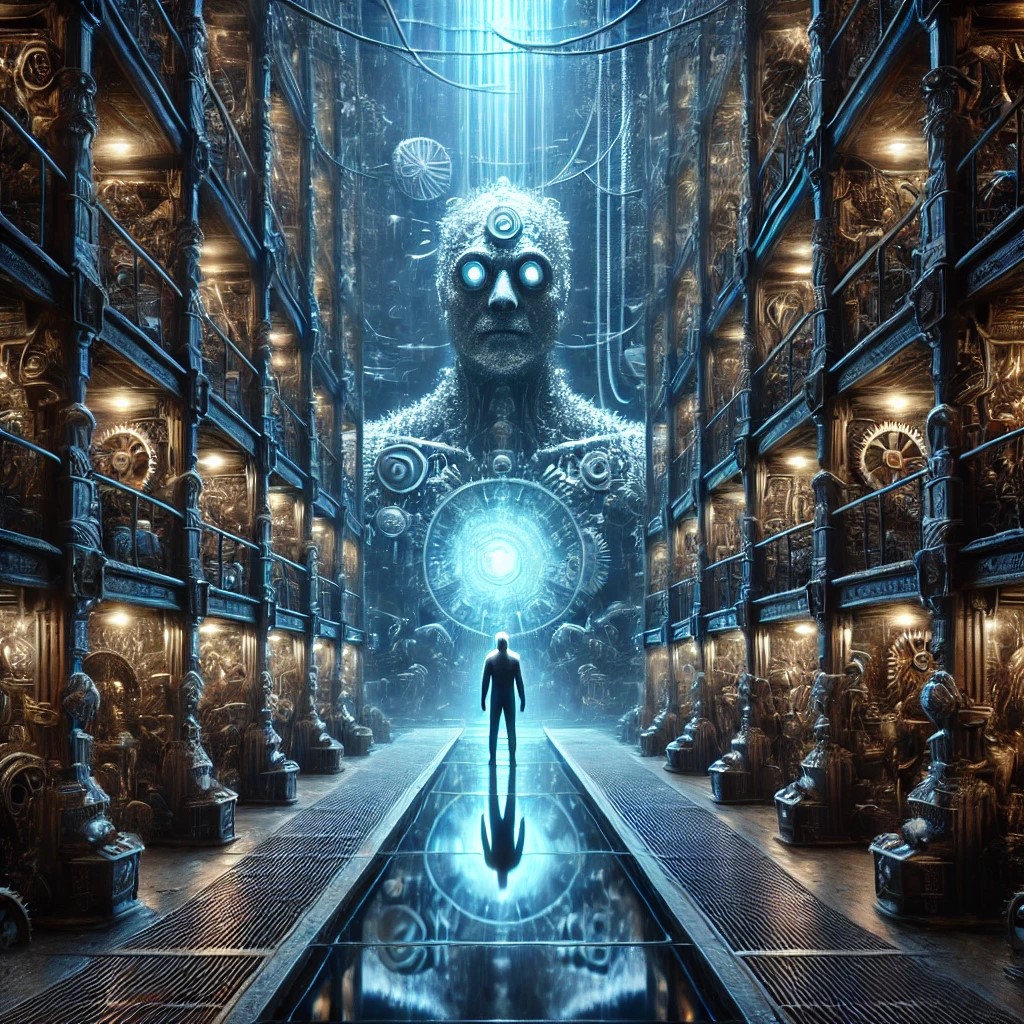
The conversation shifted, but his words lingered. That night, I dreamt again. This time, I wasn’t just an observer. I was walking through a vast, labyrinthine space—a warehouse or factory, its walls lined with towering shelves stacked with parts. Not clock parts. Gears, wires, and shapes I couldn’t quite comprehend. It was dark except for a faint blue glow emanating from the far end.
I reached it.
And there, amidst the machinery, I saw myself.
The next day, I couldn’t shake the dream. I went back to Alden’s shop, desperate for distraction. He greeted me warmly as always, but when I hesitated at the counter, he leaned forward.
“You’re troubled,” he said, not unkindly.
“It’s nothing,” I lied. “Just a weird dream.”
“Ah.” His eyes narrowed slightly. “Dreams have a way of speaking to us, even when we don’t want to listen.”
I don’t know why, but I told him everything. The ticking, the blue light, the uncanny moment of seeing my own face. He listened without interrupting, his fingers idly tracing the edge of a brass clockwork plate.
When I finished, he regarded me carefully. “There are places in this world—and beyond it—where time behaves… differently. It’s possible you’ve glimpsed something. Or someone.”
“Someone?” My laugh was hollow. “Like a future version of me?”
“Perhaps.” He shrugged, but there was weight in his gaze. “Or someone who reflects a piece of yourself you’ve yet to understand.”
Over the next week, the dreams grew worse. I stopped going to work. I stopped seeing friends. My days were spent in a haze, and my nights… well, they weren’t my own anymore.
The dream changed again. This time, I was no longer alone. The glow revealed others—dozens, maybe hundreds—moving mechanically, as if performing tasks. They didn’t seem human. Their faces were blank, their movements unnaturally precise. I felt an overwhelming urge to run, but my feet were rooted. That’s when I felt it: a cold hand on my shoulder.
I woke up screaming.
I went back to Alden’s shop the next day, though I could barely stand. The shop felt different. The air was colder, the shadows longer. Alden didn’t look surprised when I stumbled in.
“I need answers,” I demanded.
He sighed deeply. “Some questions are better left unanswered.”
“I can’t sleep. I can’t think. I need to know what’s happening to me.”
For a long moment, he said nothing. Then he reached below the counter and placed a small box in front of me. It was old but meticulously crafted, its surface inlaid with intricate patterns of brass and ivory.
“This,” he said, “is The Clockmaker’s Gift. It’s not for sale, but I’ve kept it for someone like you.”
“What does it do?”
He hesitated. “It will give you clarity.”
Despite my exhaustion, I hesitated. There was something deeply unsettling about the box. “And if I don’t want clarity?”
“Then leave it,” he said simply. “But if you take it, remember: the truth isn’t always what you hope it will be.”
I took the box.
That night, I couldn’t resist. My hands shook as I opened the lid. Inside was a key, simple yet exquisite, and a folded scrap of paper. The paper bore only two words, written in an elegant hand: Wind it.
There was a small compartment beneath the key, just the right size for winding. I inserted it and turned.
The ticking began immediately.
The dreams stopped, but the world began to shift. Subtly at first. I’d see people in the street who didn’t seem quite real—like those figures in my dreams. Once, I saw my own reflection in a shop window, but it wasn’t me. Not exactly. The edges of my reality seemed frayed, as if I were peering through a veil.
I went back to Alden’s shop, clutching the box. But the shop was gone.
Not just closed—gone. The alley where it stood was empty, the space now an unbroken wall of bricks. My heart raced. I called out his name, pounded on the wall, but there was nothing. No one.
The final dream came the night after. Except it wasn’t a dream. I was back in the warehouse, the blue light illuminating the endless expanse. This time, I didn’t walk. I ran. My breath came in ragged gasps, my pulse thundered in my ears, but I had to find it—find me.
When I reached the end of the labyrinth, the figures turned to face me. They weren’t human. They weren’t even alive. Clockwork. Every one of them. The rhythmic ticking I’d heard in my dreams was the sound of their mechanisms.
And in the centre, I saw it: a machine larger than anything I could have imagined. It pulsed with that blue glow, its surfaces shimmering with impossible patterns. And standing before it was Alden.
No, not Alden.
It wore his face, but its body was metal and gears, its eyes a piercing green light.
“You wound the clock,” it said, its voice no longer soft. “You invited the truth.”
“What truth?” I whispered, my voice barely audible.
“You are not who you think you are.”
I shook my head. “No… I’m human.”
“You were,” it said, almost kindly. “But your time was up. And so you were rebuilt.”
Rebuilt. My mind reeled as fragmented memories surfaced. Flashes of a car accident. My body crumpled and broken. And then… the ticking. Always the ticking.
“Why?” I croaked.
“To serve,” it replied simply, gesturing to the countless figures. “We are the Clockmaker’s creations, and now… so are you.”
I stumbled back, my hands trembling. The ticking grew louder, deafening. I reached up to cover my ears—and felt something cold and metallic where my temple should have been.
The last thing I saw before darkness claimed me was my reflection in the machine’s polished surface: a clockwork being, my humanity ticking away.
And then, silence.


 Endless Horizons